
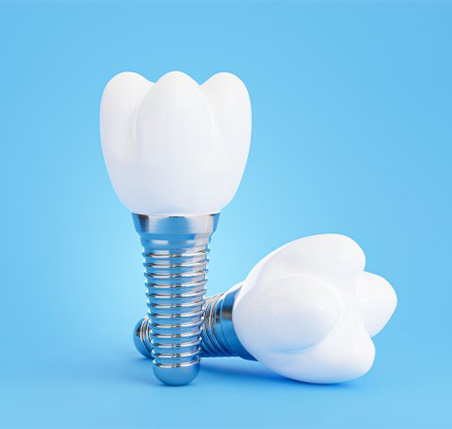
The team at Towson Implant & Surgery House sets the record straight on the misconceptions that keep patients waiting longer than they need to.
Most of what keeps people from getting dental implants isn’t the procedure itself — it’s what they’ve heard about it. Old information, one bad story from a friend, or a myth that was never quite true to begin with. Here are the five we hear most often, and what’s actually true.
✕ MYTH #1
“Implant surgery is unbearably painful.”
✓ THE FACT
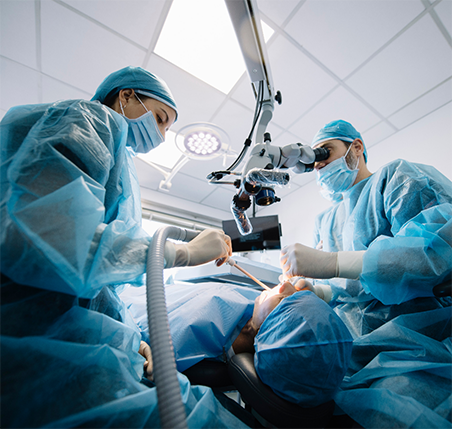
Local anesthesia is used for every implant procedure, and most patients describe the experience as far less uncomfortable than they expected — many say it’s easier than a routine extraction. For patients who feel anxious, nitrous oxide is available to help you stay relaxed and comfortable throughout, without replacing the anesthesia that actually controls pain. Most discomfort in the days after surgery is mild and manageable with routine care.
✕ MYTH #2
“I’ve lost too much bone — I’m not a candidate.”
✓ THE FACT
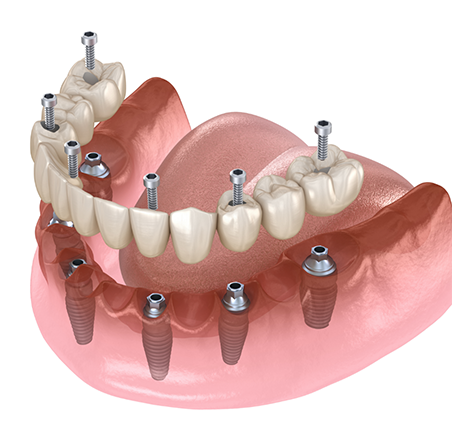
This is one of the most common reasons patients think they’ve been ruled out — and one of the least final. Bone grafting can rebuild the site needed for a standard implant, and for the upper arch, a sinus lift can add volume where it’s naturally thinner. All-on-4® and All-on-X approaches often avoid the need for grafting altogether by placing implants at angles that use the bone you already have. Precise 3D imaging is what makes it possible to know for sure — not a guess based on an old X-ray.
✕ MYTH #3
“You have to wait months after losing a tooth before you can get an implant.”
✓ THE FACT
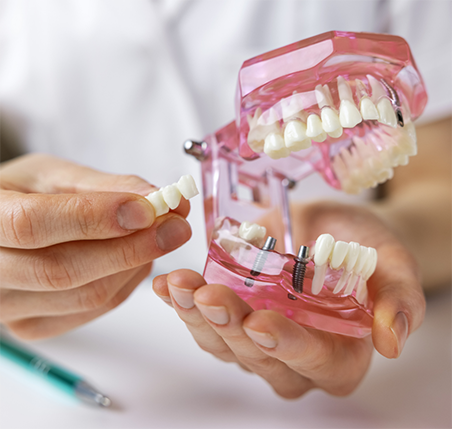
For many patients, extraction and implant placement can happen in the very same visit. For full-arch cases, All-on-X treatment can go from surgery to fixed, functioning teeth within 24 hours using in-house digital scanning and 3D printing — no waiting on an outside lab. Same-day treatment isn’t right for every case, but it’s far more available than most patients realize.
✕ MYTH #4
“There’s no way I can afford implants.”
✓ THE FACT
Most dental insurance plans cover portions of the process — extractions, grafting, sedation, and sometimes part of the implant or crown — even when “implants” aren’t listed as their own category. On top of that, CareCredit and Cherry offer payment plans stretching up to 60 months, which can bring a monthly payment down to around $120. Our in-house plan is simpler still: 35% down on surgery day, the rest due six months later.
✕ MYTH #5
“Dentures are the cheaper, easier choice in the long run.”
✓ THE FACT
Dentures often look cheaper up front, but the comparison changes once you look past year one. A removable denture typically needs relining or replacing every 5–8 years, and it doesn’t stop the jawbone from gradually shrinking underneath it. An implant, cared for like a natural tooth, is built to last decades and actually helps preserve the bone it’s anchored to. Priced per year instead of per procedure, implants are very often the more economical choice — not the more expensive one.
| Still not sure which myth applies to your case? Come in for a real evaluation — a 3D scan, an honest answer, and a personalized plan, no matter what you’ve been told before. (410) 520-1440 · 120 Sister Pierre Drive Suite 103, Towson, MD 21204 |